Saturday, January 21, 2012

Farrier Back

One of the most asked questions I get when I am shoeing a horse is, “How does your back hold up, doesn’t it get sore?”

After 30+ years of shoeing, I have to say for the most part I’ve been blessed with my back holding up. There have been times that my back has “gone out”. And after a few horses in a row, anymore it can take me awhile to stand up. It’s almost as if as long as I am bent over it feels good. And so I can’t really say it hurts, it has just gets stiff.

I contribute a number of factors or theories to why my back is holding up:

  • God gave me a certain body type that is conducive to this line of work.
  • When I was learning to shoe, my instructor made me hold the hoof in the various work positions without the use of a hoof stand. (thanks Scott!) This helped me to remember to keep my knees bent; like in many sport activities this allows the weight to transfer to the thigh muscle and a more athletic stance for balance and agility in moving when the horse moves. So now that I do use a hoof stand my knees are bent and my back stays straighter.
  • I don’t worry about having all my tools with me next to the horse for the whole shoeing procedure. This forces me to stand up, walk to my truck, and change from trimming tools to nailing tools, to clinching tools. I think the standing up and walking even a few steps helps the health of the back.
  • On that note, I love to walk in the mornings before shoeing and/or in the evenings. And I really think that has helped.
  • I am a big believer in a good chiropractor. And times when I felt bad twinges I would get an adjustment. And mid way through my career I found that a deep massage by a knowledgeable masseuse who understood the connective relationship with muscle, tendons, bones, etc was the best therapy.
  • Just recently, I got to thinking about my bed. It is a waterbed and though it is outdated and there are a few things I don’t like about it, I really should give it credit. There is much talk out there now about all these expensive mattresses and how memory foam or your own sleep number contributes not only to a good nights sleep but also to your health. Well, by golly, maybe keeping the ole waterbed has helped!
  • Habitually drinking plenty of water even on cold winter days also is one of my theories to a healthy back.

Good thing folks don’t ask about my shoulders, elbow, forearm, or hands because those are what can get to hurting!! And I hate to complain! Of course I call it whining. Let me quickly define:

  1. Complain is when you stop doing what you need to do and gripe about it.
  2. Whine is when you keep doing what you need to do and gripe about it.

Friday, December 23, 2011

Winter Work...Merry Christmas


Well, this time of year can be slow for us Farriers in the northern hemisphere. This year I have been blessed with a nice schedule of work to keep the bill collectors at bay. But still not so busy that I didn’t take on a one-time-of-year unusual request.
I got this phone call, still don’t know if he got my number from our local horse newspaper, craig’s list, my card at the local feed store, or perhaps word-of-mouth.
My phone rang and caller ID read ‘private number’, I answered and through a scratchy connection I hear a low laughter, kinda like a Ho Ho Hello. I thought I heard phones jingling in the background and thought, “great, it’s a telemarketer”.
The guy on the other end asks if I only do horses and I replied I do ponies, donkeys, and mules too. He gently asks, “How about animals with feet like…. goats” I thought , “okay, I told those people not to tell anybody I trimmed their goat for them. I only did it because they were desperate and were regular horse shoeing clients”. But being winter and short on work I asked what he had. The answer was “Ho, Ho, Of course reindeer.”. And he would be willing to pay for mileage or provide transportation to his place. Because he lived way North of me. Well, there is a wildlife zoo somewhere about 100 miles North, but he said he lived further. And to meet him at the Minden airport with my trimming tools and he’d fly me up to his place.
Well, you can imagine my surprise flying on a sled behind 8 tiny reindeer to the North Pole. I nipped away on a cavvy of over 30 reindeer! I found out that they only needed done about this one time a year. Normally, their large, spreading hooves enable them to travel on snow-covered areas and they naturally wear them off when they scrape away the snow cover to feed on buried vegetation like grasses, mosses, and lichens. But soon he would be making a big circle, periodically changing out critters and they would be traveling to places without snow and eating on fodder such as hay, sugar cubes, and oats set out at various stops by folks with good intentions, but the ease and richness of the feed will play havoc on the hooves.
Why me you ask.? Well, he picks seasoned farriers of over 30 years experience. So if you are just starting out in this wonderful trade, hang in there for not only years of working in a great occupation, but someday….down-the-road, your phone may ring from a private number and when you answer, by-the-way those are sleigh bells in the background, don’t turn down this new one time client!! And those of you who have been in the trade for a while, I’d love to hear about your story of finding the correct balance for those critters.
MERRY CHRISTMAS & A HAPPY SHOE YEAR

Sunday, October 16, 2011

Trim 1 day /Shoe the next

Another short blog entry. I have a few horses in my rounds that I would love to trim the hooves one day and in 1-3 days return and actually put the shoes on the horse. Actually one of the horses that I end up doing this on is one of my own. In his case he really grows a lot of toe. By giving him a modest trim one day and shoeing him 1-3+ days (whenever I get to him…he is mine after all!) I find the hooves have sort of “found their own” by either (1)wearing where the front to back balance is more appropriate or (2)if it is damp the sole has ‘released’ itself to the point I can tell what really needs to come out and how short I can trim the toe. This allows me to shoe him so he doesn’t appear long.

Often times even a little time can help when letting the hoof “tell” you how much to trim. I have found that if I question my trim i.e. thinking more hoof needs to be trimmed, but am questioning the sole depth, I can go on to the other feet and give the foot in question 10 – 20 minutes of rest after an initial trim and little fissures can appear in the sole to let me know to trim more.

Unfortunately, customers either don’t want to pay me to come 2x’s in one week, the horse is rode everyday with no time to be barefoot, or they are not available to schedule the 2 day shoeing job!

Oops! I pulled my horses hind shoes the other day...I better get out and get those shoes on if I want to ride…we are rocky, rocky, rocky!! Ahhhh, I can barely afford my own theories!!

Monday, July 18, 2011

donkey trim


This will probably be a short one….I don’t know who reads this, if anyone, but for my documentation I want to post my theory about trimming donkeys, burrows, and even their half relation, the mule. One of the guidelines/rule-of-thumb farriers use now to help determine a balanced trim is stated similar to: “trim the heels to the widest part of the frog”. However, I find this does not apply to the above-mentioned critters. I notice that a large portion of the donkey’s frog typically is aligned to set behind the heels. Am I wrong? Can someone comment to let me know if I am way off track?

pic 1 donkey

pic 2 trimmed

pic 3 untrimmed


Tuesday, May 24, 2011

Farrier protocol for EHV-1 concerns

For the last 1 ½ to 2 weeks people in the horse industry have been concerned with the Equine Herpes Virus-1 (EHV-1). Whether it is a personal concern to not let their horses contract the disease or to help stop the spread, events have been cancelled/postponed and some training/boarding stables are closing the gates to horses and horse people coming and going. Some don’t want outside horses to enter or boarded horse to re-enter if taken off the premises. I’ve seen a posting to stay-off farriers.

At the outbreak of the news, I was heading to a stable when I received a phone call from the owner that there would be a spray bottle with bleach for me to use on my shoes and tools. Since then I’ve had clients call asking me if we should keep the appointment and, so far, only one has postponed. I am trying to stay pro-active by following protocol standards given to me by a vet.

  • Wiping tools with Clorox wipes
  • Spraying chaps, buckets, shoes, anvil and stand, etc with a disinfectant. ( I even spray my ponytail!)
  • Carry a change of shirts.

Nevada just in the last day or two had its first confirmed EHV-1 virus case. We may be overreacting, but I want to keep working and feel I can do my part to help the concerns of my clients.

Most of my clients are “backyard” horse people so these horses don’t go too far from home anyway. Around here, many folks were just gearing up for the summer show and trail season so hadn’t gone far from home yet.

An old shoer once told me “your backyard horses are your bread and butter…. If you have one that quits you; you’ve lost maybe 1-3 horses. Where as when a big barn clientele quit you, you can lose a weeks worth of wages (times 5-6 per year).” Now that I am the old shoer, I’d add that when a virus like this threatens the horse world, the backyard horses are the backbone to your business because they are less exposed and can stay safer and can stay on the farrier’s books!! As a farrier, it may be fun to talk (brag) about the fancy show barns you have, but I really love to brag on my clients who have 1-3 horses that they cherish. I am honored that they hire me to provide the hoof care.

Thursday, March 3, 2011

quarter crack


This horse has a awesome quarter crack due to a traumatic cut on his left outside coronary and bulb area. When I first starting shoeing this horse he had wedge pads and clips. I saw no need for the wedge after trimming the hoof. At first we were using clips, but this crack is not going to heal due to the injury coming from the hoof growth area.
First Horse's Purpose:The owners want to use the horse in the mountains and need him sound and shod in a way that will help ensure not losing a shoe. I firmly believe in the KISS method (keeping it simple...)
Second Evaluation: The best improvement for this hoof was to keep the foot fall and weight bearing where it should be. Ease the breakover both laterally and keep comfort to any medial movement. This crack tends to expand when the hoof is off the ground and closes slightly when weight bearing.
Third Shoe method applied: I trimmed to a 1/3 in front of frog apex and 2/3 behind style. I modified a keg shoe into a " Square" rolled toe (natural balance type)This helps foot fall and weight bearing. I used a light rim which I feel offers ease of lateral movement. I did not apply clips because of the fact that weight bearing actually closes the crack somewhat and felt they weren't needed. I did drive the 4th nail from back to front so it went from behind the crack, through the inside of crack, and clinched in front of cracked. I rasped flares and the deformed section on the rear end of the outside hoof wall; trying to make it look nice which I feel sometimes improves the condition..."If it looks good, it is good" This may not always be the case but I bet in 80% of the cases if you help the hoof look like a hoof you are doing the right thing.

Thursday, February 3, 2011

Trimming a Long, Mis-shaped Hoof

Okay, my 1st attempt at adding photos along with text.
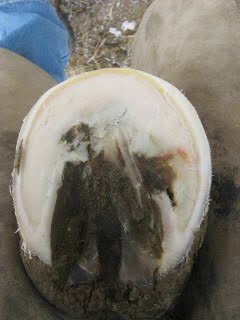
Here is a very misshapen front left hoof. There is not one particular thing wrong except it is run a-muck. It is long in the toe, but also, the heels have run forward. The 2nd photo is my attempt to initially trim half the foot to begin showing the process of bringing the hoof back to its norm. Notice the difference in heel length/placement. The untrimmed side is too far forward. The red on the trimmed side is bruising from having the heel and bar region compressed in the wrong configuration and taking weight that wasn't distributed properly. (at least that is my guess) The third photo shows the hoof trimmed, notice the more rounded shape. The bar on the bruised side was broken so I removed it. the frog "wanted" to disappear into the sole which indicates that the hoof was elongating too much at the toe. And typically the sole can be removed so you can see the true apex of the frog. Which is one indicater to use to help in gauging how much toe to take when you don't have x-rays. this horse was toed out and still is toed out due to conformation. Most of my decision on how to trim a foot comes from what I see on the ground surface of the hoof. When everything a lines on the bottom you can pretty much have a balanced foot, minus having to remove flares from the dorsal hoof wall.
Hope some of this made sense. This was my quick overview