Thursday, February 3, 2011

Trimming a Long, Mis-shaped Hoof

Okay, my 1st attempt at adding photos along with text.
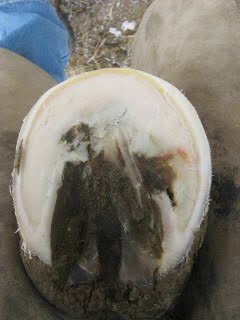
Here is a very misshapen front left hoof. There is not one particular thing wrong except it is run a-muck. It is long in the toe, but also, the heels have run forward. The 2nd photo is my attempt to initially trim half the foot to begin showing the process of bringing the hoof back to its norm. Notice the difference in heel length/placement. The untrimmed side is too far forward. The red on the trimmed side is bruising from having the heel and bar region compressed in the wrong configuration and taking weight that wasn't distributed properly. (at least that is my guess) The third photo shows the hoof trimmed, notice the more rounded shape. The bar on the bruised side was broken so I removed it. the frog "wanted" to disappear into the sole which indicates that the hoof was elongating too much at the toe. And typically the sole can be removed so you can see the true apex of the frog. Which is one indicater to use to help in gauging how much toe to take when you don't have x-rays. this horse was toed out and still is toed out due to conformation. Most of my decision on how to trim a foot comes from what I see on the ground surface of the hoof. When everything a lines on the bottom you can pretty much have a balanced foot, minus having to remove flares from the dorsal hoof wall.
Hope some of this made sense. This was my quick overview

Sunday, January 23, 2011

Goal Post

Really not much to creatively write. But I do have a goal of trying to post at least one time each month. I may have missed a few times. This year I am thinking of making it my goal to take some photos while out shoeing and publish to my blog. I have acquired a few clients with horses with hoof cracks. I like dealing with cracks. So it might be fun to document any changes, as well as, the type of cracks. I have posted a few times in the past some about cracks and the different types. Since I have a digital camera it should be easy to post pictures.
Talk about pictures....I had a photo of me along with a short interview type article in the Western Horseman magazine this February! ( this issue is out to subscribers already) Jennifer Denison, senior editor, used me in the Women of the West section. It was fun and scary to have that "honor". Hope anyone who read it enjoyed it and I hope people I have met along the way will remember me if they see the article.
2011- Here We Go!

Thursday, December 23, 2010

Farrier serving Jesus

If I was a farrier back then, before they went to Bethlehem

Joseph may have used my service to give that donkey a trim

He knew of the rough country and the burden of Mary with her unborn baby.

Before Jesus was born I may have served Him.


Like always, it would’ve been good to stay on trimming schedules

Because men were coming to kill all the young males

So when King Herod set the decree, the donkey was ready to help the family flee

Down to Egypt over rocky trails.


Through most of His years He walked around and fed people lunch

He was a carpenter who healed, did miracles and such

The next horse He rode I probably didn’t trim, because it was not broke, I am told

I guess then He didn’t need my service much.


But I know He kept my name and number for future need

I believe He is coming back, so my name is in that Book, indeed.

Every horse I shoe I keep the clinches tight, because He’ll be riding when He comes for the last fight.

And maybe He’ll choose me to shoe the mighty steed.

Monday, November 22, 2010

THANKFUL

With Thanksgiving around the corner I want to take this space to share a little prayer written by Gina Keesling who operates Farriers' Greeting Cards. I love my profession and am thankful to God that He continues to keep me of sound body to stay in the shoeing business. Thanks to my clients, the people AND the horses.
Here is the little prayer which I claim but did not originate!

A Farrier’s Prayer
By Gina Kessling

Dear Lord, give me strength to start this day
And wisdom and courage to face whatever I encounter in my travels.

Even though my work with horses is difficult and dangerous,
Grant me patience for his flighty and unpredictable ways,
And keep me safe from harm as I do my task.

Let me remember that my satisfaction comes from helping
A lame horse to go sound, and a sound one to do his job with comfort.

Help me to have patience with my fellow humans, and to remember that
Most love their horses and want what is best for them.

Let me have respect and fellowship with my peers so that we are
Not alone in this complex and challenging vocation.

Remind me that while my work is important, faith and family should
Come first; help me to schedule my days to reflect the priorities.

And at the end of the day, when my mind and body are tired,
Help me remember why I chose this profession,
And never let me lose fascination and reverence for this
Wonderful creature You have given us, the horse.

AMEN

Wednesday, October 6, 2010

Shoers Can Have Similarities

Wow, the weather was so nice through September I never wanted to really sit and write an entry. Now, we have had 3 days of rain and I figured I’d think of something to write about.
I “always” say if you get 10 shoers together you would have 11 different ways of doing things. It seems we are that independent, as well as, human even in application of similar techniques of trimming, shoeing, and horse handling. Well, I finally met a shoer that would have been fun to have met years ago. She wanted to quit shoeing and was looking for someone she felt she could recommend to her clients. She saw some of my work and even though the horse was overdue and scheduled to be shod later that day she thought the work looked similar to her standards. We met for lunch and went to shoe a few of her clients’ horses together. And I “passed” her critique. And I had a blast shoeing with someone else. And I had been praying for a little more business (“Oh that you would bless me indeed and enlarge my border, and that your hand might be with me and that You would keep me from harm that it not pain me” I Chronicles)
Differences:
· She has a trailer/ I shoe out of a truck with a topper
· She uses electric power to grind shoes/ I hot rasp
· She finishes really clean/ I enjoyed buckling down to clean up my work
Similarities:
· We both are in our 50’s (however, I am a little younger!:) )
· We both put emphasis on hoof balance, good nail placement, horse handling, scheduling & showing up on time. Our hoof trimming and shaping the shoe to the foot was of the same caliber.
· We even had similar one-liners and comments! Very important to keep your sense of humor.
· We actually are built very similar, but she is much prettier!
In the end she found what she wanted, a shoer she was comfortable recommending and has quit except for her own horses which she said I might be getting a call from her to do them! And I got my business topped off with some great clients.

Monday, August 9, 2010

Farrier Fly course

Okay, I might be just a dumb horseshoer, but I did take an entomology course in college. But as with many things, the school of hard knocks can give you the best education. I am still learning the wax and wane of the bug cycle here in Nevada, but it is a little similar to what I observed after years of shoeing in Wyoming. And as a shoer, I find it important to know what pest is bothering the horse. Flies are not just flies. There are horse flies (green heads and black & yellow ones), deer flies, house flies, barn flies, nose flies, and then you still have a few types of bees that are pests to watch out for when working under a horse. (Not to mention mosquitoes)
I find that these bugs show up in the above order throughout the summer. The horse flies typically just bother horses (not people), and give a little warning. It is though they land on the horse and pester them enough to make the horse begin to switch its tail and even hunch up back muscles before they go for blood. Then is a good time to have your horse handler seek out the big nasty looking bug or put down the foot and swat the fly. For some reason most (not all) horses seem to know when you are slapping a fly off their backs and not just disciplining them. Its like they stand for the fly slap, but the same slap to make them stand still makes them cringe or jump away. Go figure…I think it is cool that most “know” the difference.
Now deer flies seem lighter and give no warning. They have a quick needle-pricking bite and I know this because they seek horse and human flesh alike.
What I call barn flies (the above mentioned house flies shouldn’t bother the horse unless you are shoeing in the house!) are tiny harmless-looking black flies that seem to really annoy the horses’ legs. It you are holding a foot up and see these flies on other legs and if you can reach over and brush the affected leg you can keep working. If your horse holder can just periodically brush the legs with the lead line this also helps. Otherwise, the leg that is being held needs to be put down so the horse can stomp the leg that is pestered by the little flies. Or just continue to struggle with a twitchy horse.
Later in the summer I find little nose flies and sometimes a little sweat-type bee shows up. These will kill you…well, not the pests themselves, but the horse could because the horse gets to striking at their nose and you better not be in the way of those seriously, fast, hard flung hooves.
You say, why write about the flies being a problem, just use fly spray!?! Well, I really haven’t found anything that works for very long. When I use spray I like to put it on the horse I am working on and have another horse close by that isn’t sprayed….Sort of like a scapegoat scenario. Stuff that is wiped on seems to work better than most sprays, but anything that really seems to work that clients wipe on their horses can give me a headache, but I’ll put up with that versus getting killed by a kicking horse. I’d like the horse owner to be prepared with a fly repellent to use on their horses instead of using my own. Number one, I think that is the courteous thing to do for the farrier. But secondly, I may use something that the horse reacts to. One home remedy is a combination of water, vinegar, and dish soap, but it shouldn’t be used where the saddle pad goes as the soap can irritate the skin.
Fly season is just another reminder on the importance of having someone holding the horse who understands not only where to stand, when to move, but also, how to deter pests from bugging the farrier and horse.
So there is a short course in entomology from the ground up. Yes, I even have more thoughts and theories and remedies on flies, but I don't want to bug you any more in this read. ...Now that was pretty poor...

Friday, June 25, 2010

Moisture in hooves

Summer is here, which not only means less computer time, but also, typically drier conditions for us here in the desert country. This year is a little cooler and looks like thundershowers will be more normal. (like today). But hooves dry out and can become abnormally hard. So I thought I’d touch on my opinion of helping the hooves (and the farrier!)
Textbook figures on the moisture content of the hoof structures to be the sole should be 33%; the hoof wall at 25%; and the frog’s moisture content should be around 50%. So what does that mean? Simply the moisture content is important and normal to these structures. So it is not natural when the frog is as hard as the back of my head! On the other hand it is not normal these structures are way too soft.
I am all for overflowing the water tough to make a mud hole (or if you have a fancy watering system get a hose and create a mud spot in a location where the horse has to go). Otherwise, use hoof dressings. Pick a hoof dressing with pine tar. If the product is something that you want on your hands as a lotion I’d keep it in the house and get the stuff you want to wash off your hands! I think it is best to use hoof dressings before the hoof becomes dry. Otherwise it needs to be applied 5-6 times /week until it begins to work and then decrease the times/week accordingly. If your horse has super dry and hard feet and your farrier is scheduled to come take some time (minimum one hour) to hold your horse in a wet spot. This can temporarily soften the hooves to make them manageable for the farrier thus allowing for a better, more precise trim.
If your horse’s hooves seem to be at a good moisture content and you are approaching a dry season or even a wet season, there are hoof sealants out on the market to hold the existing moisture in and not allow excess moisture to be soaked in. But as the conditions persist you need to keep applying the product, and be aware when other measures need to be taken.